
Payer Policy Database: Medical Policies, Prior Auth Lists and Requirements, and Coding Rules and Edits by Payer for Denial PreventionMore Claims Authorized and PaidLess Work
Every payer’s rules on one screen, for any date of service – so auths get approved the first time, claims go out coded the way that payer actually pays, and your AR team wins the appeals it’s losing or not doing today.
No one can know it all. The rules differ by payer, by provider type and by date, and they change constantly. Looking them up properly is a full-time job nobody has – so nobody checks, and the money stays on the table.
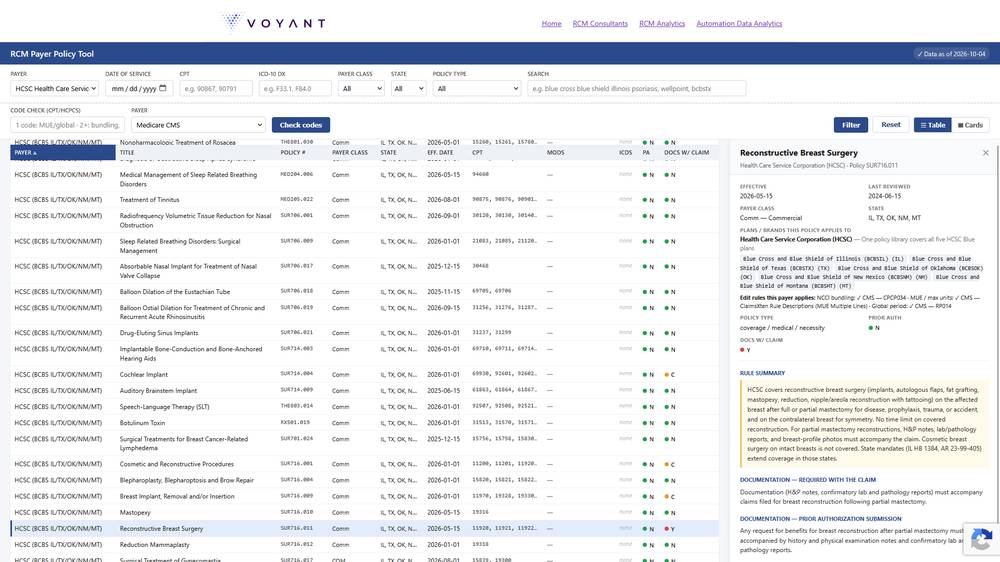
Every record links back to the source policy · Built and QC’d by RCM operators
By the Time It Denies, It’s Too Late to Fix
Two months is too late to go back to the provider
They don’t remember the visit and can’t add to a closed chart.Everything billable was already on the claim
All the diagnoses the chart supported went out the first time. Nothing is held in reserve.So you pay twice and collect nothing
Coding, submission, follow-up, denial work, appeal. Then lose.No coder can hold it all
Allowed CPTs, rev codes and procedures by provider type; which diagnoses are allowed, and which combinations. Across every payer.The rules move
A payer changes a policy on September 1st and your date of service is in April. Nobody finds that policy, let alone notices the change – and nobody connects it to the denial.Looking it up properly is a full-time job nobody has
Find the policy in the payer’s medical policy manual or provider manual, download it, read it, pull out what matters, track it for tomorrow. Daily. So it doesn’t get done.Calling the payer isn’t a substitute
Slow, often wrong, sometimes incentivized to be – and nothing in writing to appeal with.And when it isn’t denied, it’s quietly underpaid
Downcoding doesn’t bounce back with a denial code. It just pays less, and it keeps paying less until someone notices the pattern.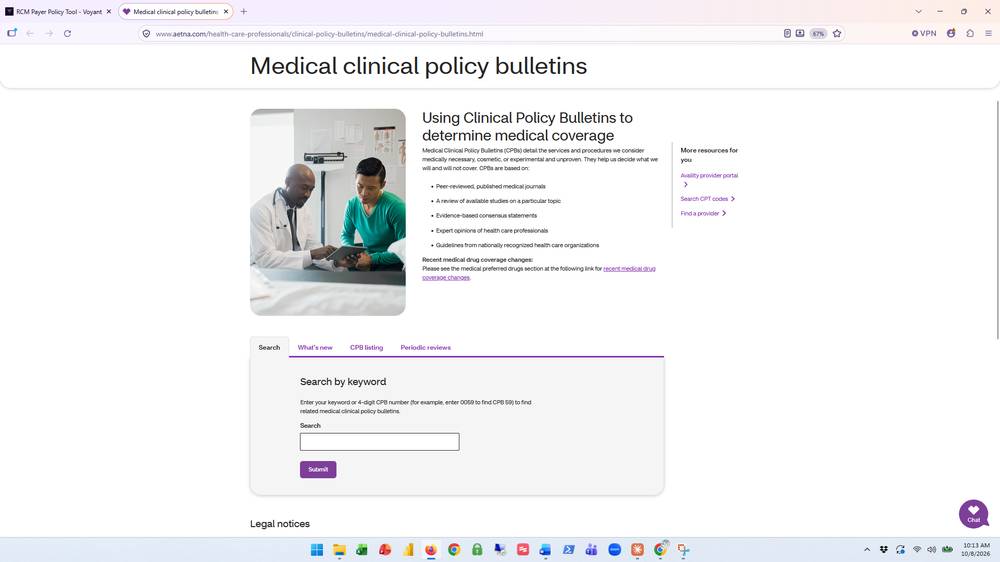
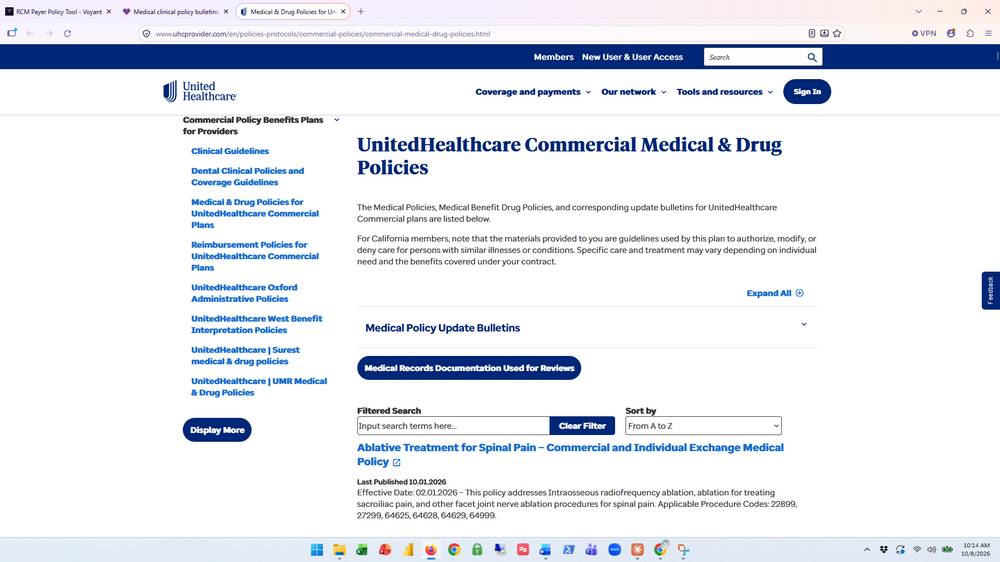
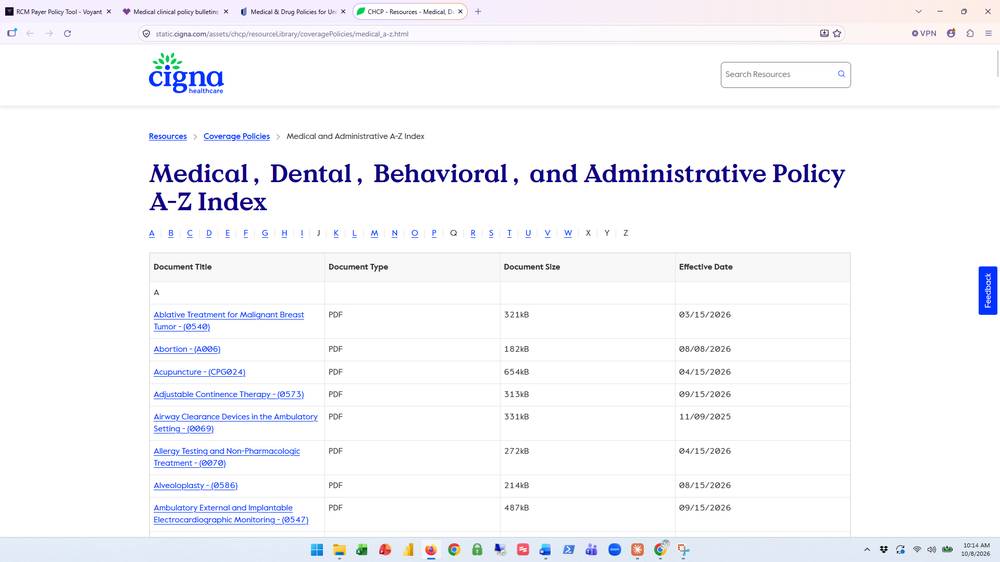
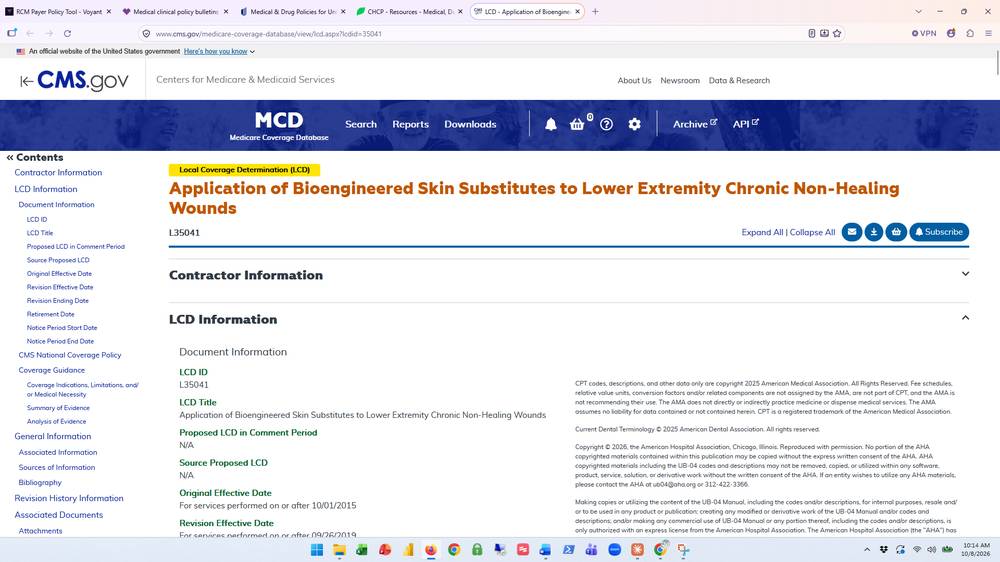
Four payers, four portals, four formats – and this is before anyone has read a word.
A Clean VOB, or Even an Approved Auth, Doesn’t Mean It Won’t Be Denied
A VOB checks the patient, not the claim
Eligibility, deductible and copay. Nothing about whether this CPT, with this diagnosis, on this date of service, meets the payer’s policy.An approved auth is not a guarantee of payment
The approval letter says so. The claim still has to meet the payer’s medical necessity, coding, modifier, frequency and place-of-service rules.The policy is what pays or denies
The payer policy database shows the rule in force on the date of service, the documents to attach and the coding the payer expects – before you submit.Watch the Payer Policy Database in Action
Six minutes, every team that touches a claim – prior auth through appeal.Like what you saw? Try it on your own specialty, or get a full walkthrough.
One Screen. Any Date of Service.
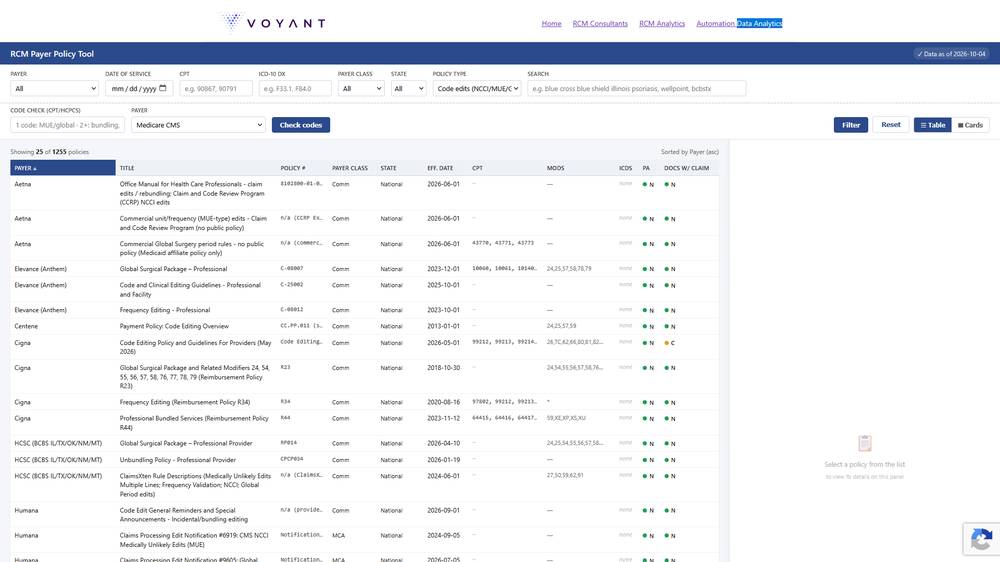
Every payer’s medical policies, clinical policy bulletins and reimbursement policies work the same way for every team that opens it.Search
A medical policy and coverage policy lookup by CPT, diagnosis, payer or keyword. CPT 15275 returns 12 policies across 6 payers. Diagnosis C44.311 returns 4. “Rhinoplasty” returns 7 across 6 payers.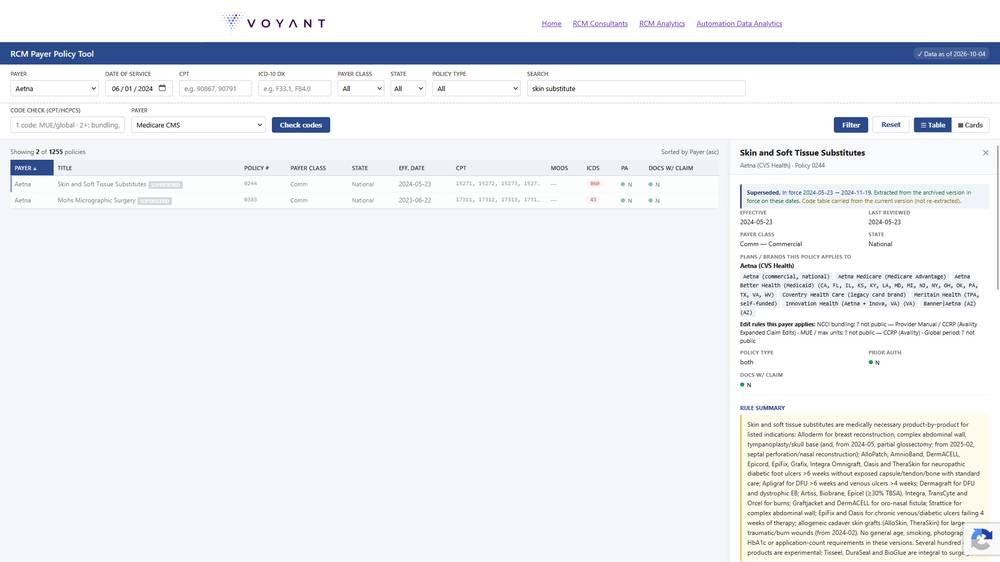
Set the date of service
You get the version that was in force on that date – not today’s. Change the date and the answer changes with it.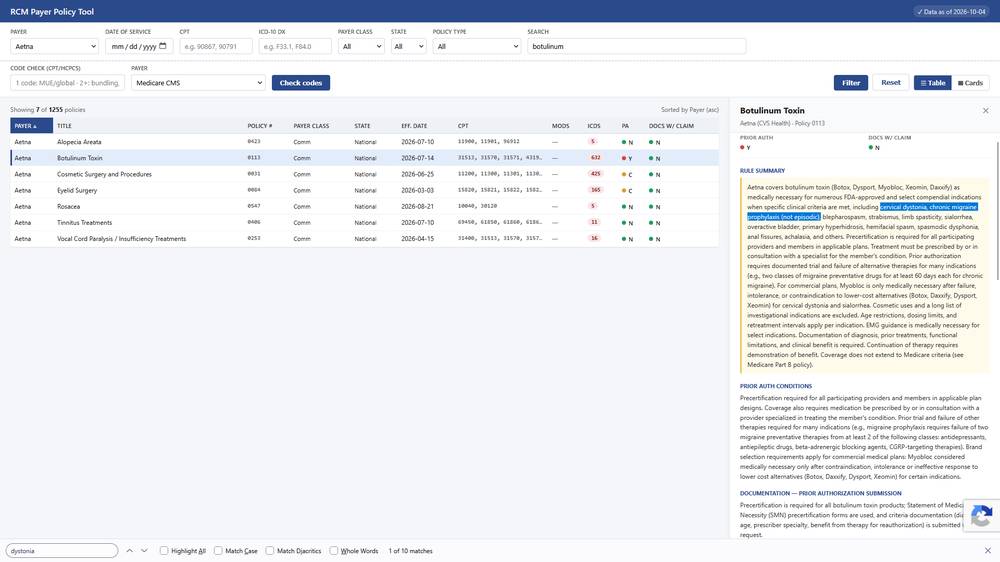
Act
Criteria, required documents, code edits and modifier values – each one linked back to the source policy.Built for All the Teams That Touch a Claim
One payer policy database. A different question from every desk.Prior Auth
“Do I need auth, and what do I have to prove?”
Every payer’s prior authorization list and precertification list in one place, with the requirements behind each code – instead of one provider portal and one PDF at a time.
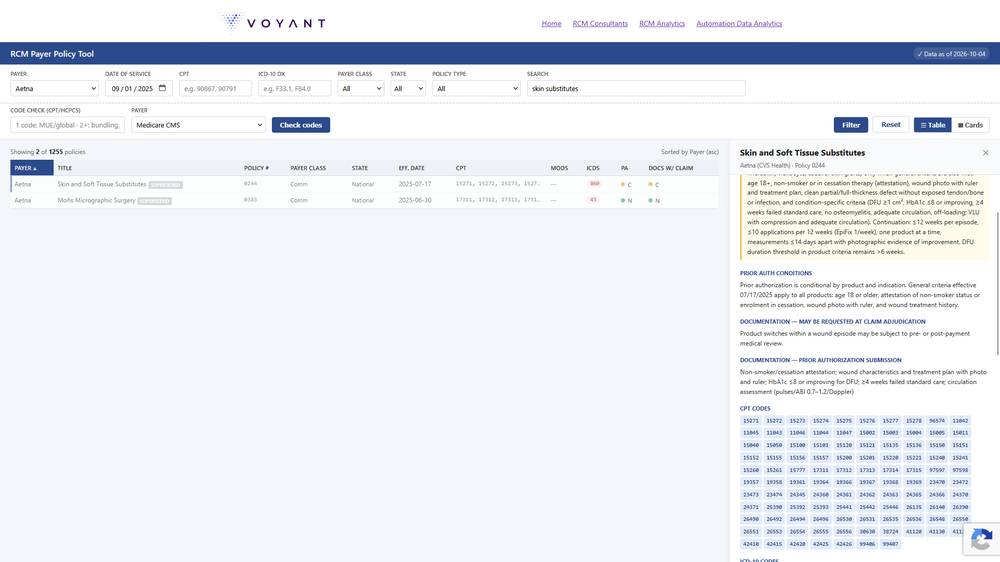
- Does this CPT need prior auth, precert or preauthorization for this payer, on this date of service? Yes, No or Conditional, with the criteria and the source policy
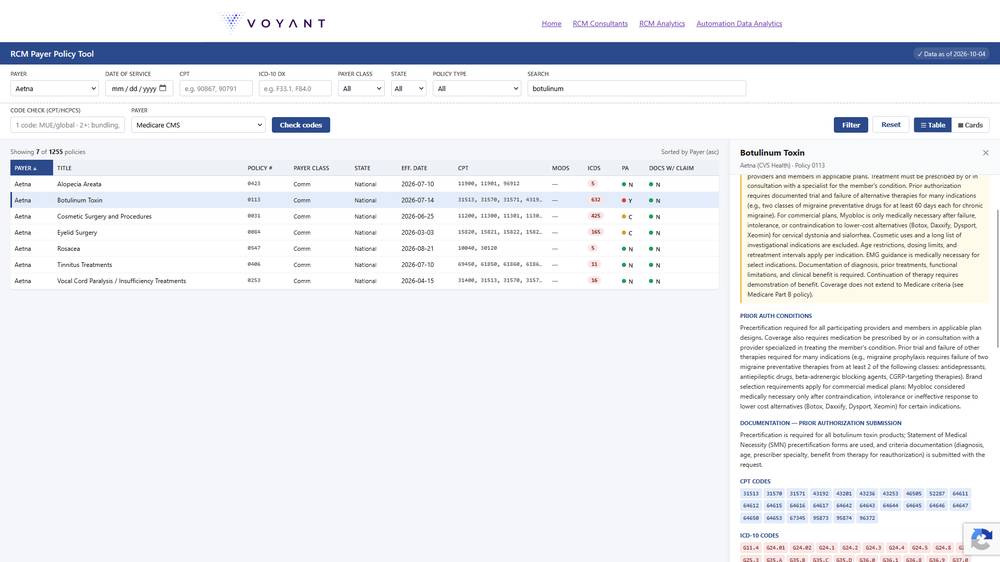
- Which procedures this payer requires auth for, with the criteria per indication – Aetna’s botulinum toxin policy lists cervical dystonia (18+, abnormal head position, limited ROM) and chronic migraine (15+ headache days a month, 4+ hours) separately
- Prerequisites spelled out – a required lab, a specific result, a coexisting condition
- Documents for the request, kept separate from documents for the claim
- Y / N / Conditional – and 87 current policies sit at Conditional. That’s the pile the auth team actually has to check, and it’s invisible in a yes/no tool.
Medical Necessity
“Will the payer agree it was medically necessary – and what proves it?”
Medical necessity criteria by payer, by indication, for the date of service – the same rules the payer’s reviewer applies.
- Criteria per indication, not one paragraph per policy – Aetna’s botulinum toxin policy lists cervical dystonia and chronic migraine separately, each with its own thresholds
- Documents for medical necessity review, kept separate from the auth request and the claim
- Criteria as they stood on the date of service, with every version kept
- Allowed diagnoses and diagnosis combinations per CPT, so the claim carries a diagnosis the policy actually covers
Coding
“What can I bill for this payer and this provider type?”
A coding and modifier lookup that answers per payer, not per code book.
- Allowed CPTs, rev codes and procedures by provider type; which diagnoses are allowed, and which combinations
- Unit-based billing, where calculating the right units is its own problem
- EAP billing codes, which differ from standard behavioral health
- Crosswalks for payers that don’t use AMA CPT – several Medicaid programs
- Site of service, telehealth, assistant surgeon and multiple procedure rules, per payer
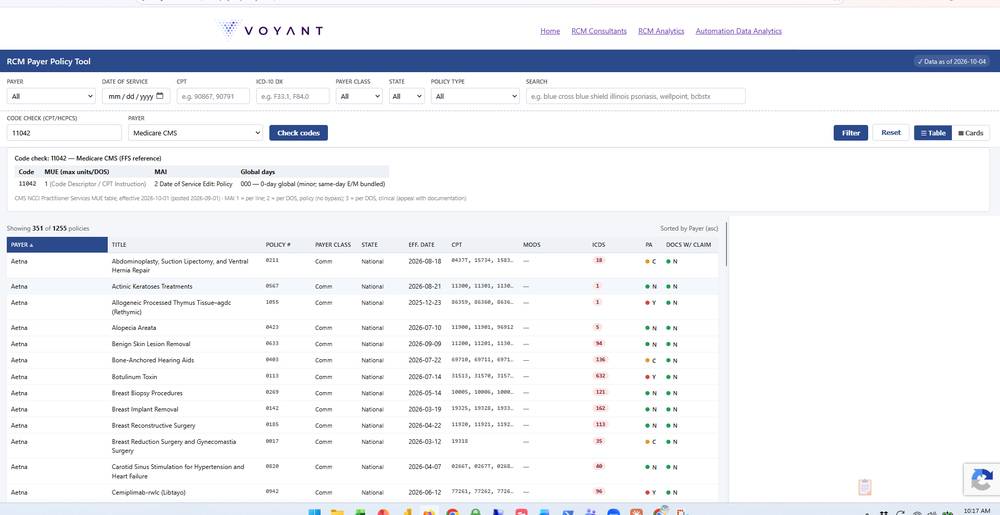
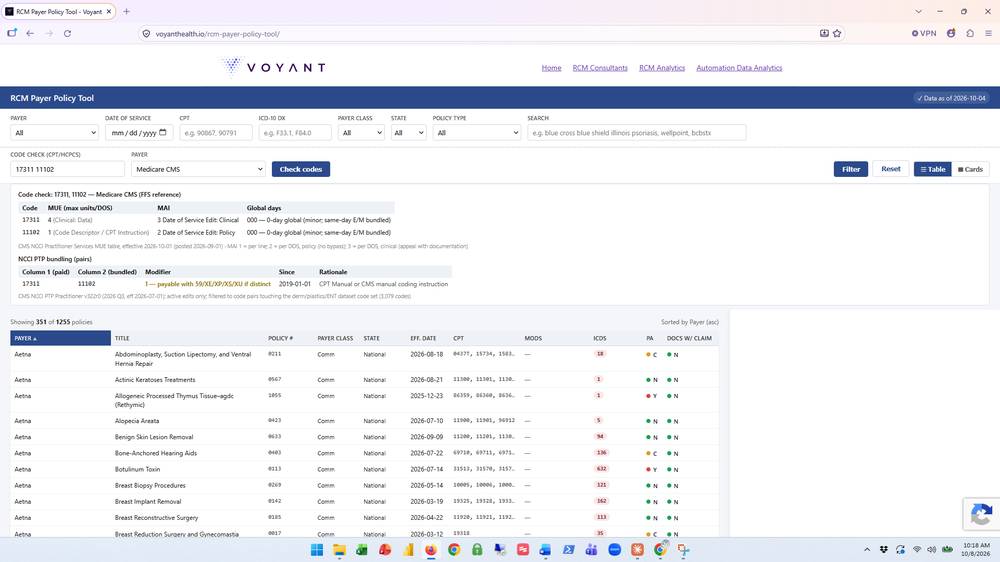
Code Check – MUE with its MAI, so you know whether a modifier can fix it and whether it’s appealable:
| Code | What the edit actually means |
|---|---|
| 11042 | MUE 1, MAI 2, global 000 – units sum across the whole day. No modifier, no appeal. |
| 11045 | MUE 12, MAI 3, global ZZZ – additional area goes here instead, and this one is appealable. |
| 17311 + 11102 | PTP pair, modifier indicator 1 – 59 or XS can separate them. |
| 17311 + 64405 | Modifier indicator 0 – nothing will ever unbundle it. |
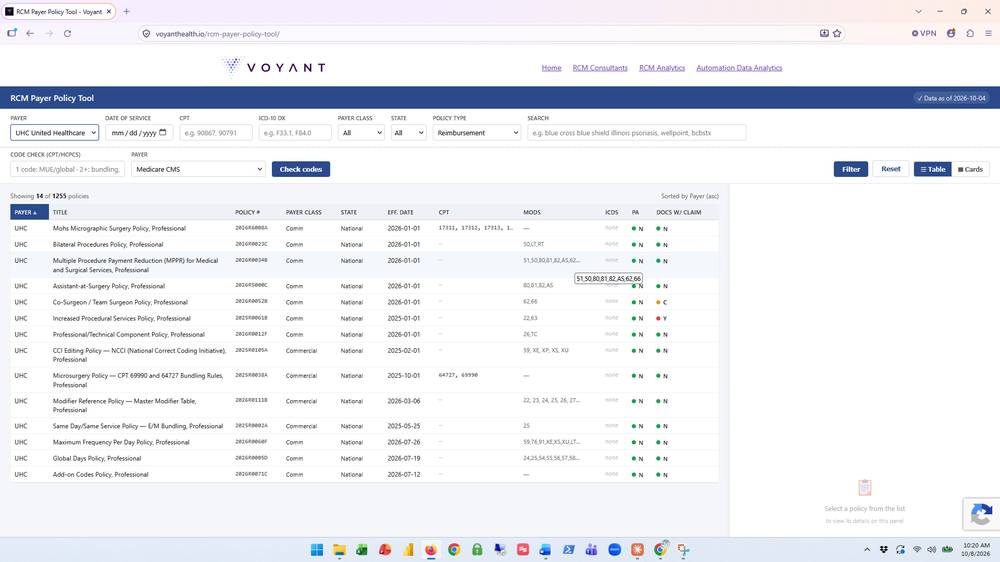
And what it pays. UnitedHealthcare’s reimbursement and payment policies for modifiers:
| Policy | Payment consequence |
|---|---|
| 2026R5000C | Assistant surgeon – 16% of allowable |
| 2026R0052B | Co-surgeon – 63% each |
| 2026R0023C | Bilateral – 150% (indicator 1) or 200% (indicator 3) |
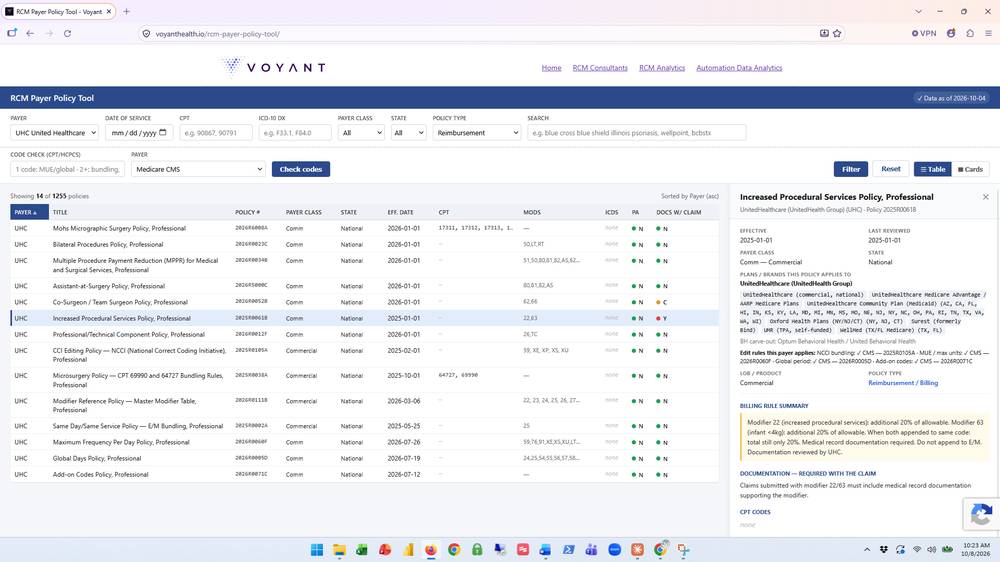
| 2025R0061B | Modifier 22 – pays +20% |
CMS tells you whether you can bill it. The payer policy tells you what it’s actually worth.
Provider-type modifiers, which also vary by payer. Behavioral-health telehealth is the clearest case:
| Modifier | Provider type |
|---|---|
| AF | Psychiatrist (MD/DO) |
| AH / HP | Psychologist (PhD or PsyD) |
| AJ | Licensed Clinical Social Worker (LCSW) |
| HO | Master’s-level clinician (LMFT, LPCC) |
Charge Submission & Scrubbing
“Will this pass edits?”
- Attach-or-deny rules. UHC 2025R0061B – claims with modifier 22 or 63 must include medical record documentation. HCSC SUR716.011 – H&P, lab and pathology must accompany breast reconstruction claims. Medicare co-surgery modifier 62 – each surgeon submits an operative report.
- You can’t attach everything; it isn’t feasible on cost or time. You need the few that matter.
- Anthem ANC00009 – three months of conservative management, photographs consistent with the diagnosis, limb measurements
Frequency and unbundling edits – every payer runs its own, on top of NCCI:
| Policy | Payer rule |
|---|---|
| UHC 2026R0060F | Maximum frequency per day |
| UHC 2026R0071C | Add-on codes |
| Cigna R34 | Frequency editing |
| Anthem C-08012 | Frequency editing |
| HCSC CPCP034 | Unbundling |
| Centene CC.PP.043 / 045 | Unbundled professional / surgical services |
Most scrubbers only have NCCI. This is the layer that’s missing.
Coding Audits
“Are we coding the way each payer actually pays – or just the way the code book says?”
Audit coding against each payer’s policies and edits, not just CPT and NCCI. A coding audit that only checks the code book misses the rules that actually deny and downcode.
- Check claims against the payer policy in force on each date of service
- Catch the wrong provider-type modifier, a diagnosis the policy doesn’t allow, and units over the MUE
- Find payer frequency and unbundling edits beyond NCCI that coders never saw
- Spot quiet underpayment: modifier payment values that pay less than you expect
- Every finding links to the source policy, so coders and providers see the rule, not an opinion
The result: less compliance risk, less rework, and fewer delayed or lost payments.
Denial Management: AR & Appeals
“Why did it deny, can I win – and how do we stop the next one?”
- Medical necessity denials sorted into the only two cases that matter: the payer got it wrong (resubmit as billed), or something has to change or be attached – and here’s what
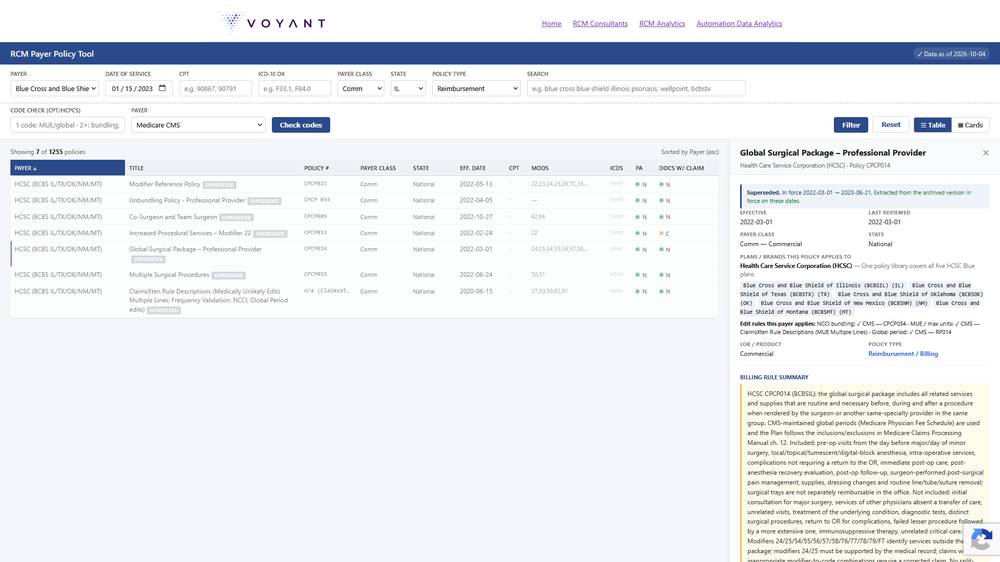
- Set the DOS to the denial date and see the rule as it stood
- Version timeline per policy – what changed, and when
- Written policy language, with its effective date, to appeal with
- Feed what you learn back to prior auth, coding and charge entry, so the same denial doesn’t come back next month
- Denial prevention and denial prediction: check each payer’s policy, prior auth and coding rules before the claim goes out, and see which claims a payer is likely to deny before you submit
Ops & Technology
“Can I stop looking things up and just build the rule in?”
- The whole library is available as structured data through an API – not a screen someone has to visit
- Feed it into claim scrubbing, denial-audit tooling or your own billing automation, so the rule fires before a human ever sees the claim
- Policy changes arrive with effective dates attached, so date-aware logic is possible rather than a manual re-check
- This is the layer that turns payer policy from a lookup into prevention
And It Tightens Documentation Upstream
Checking the policy before submission is functionally CDI. The documentation ends up correct and complete the first time – which is also what survives an audit.See it on your own payers. The trial runs on the standard library — no credentials, no setup call.
Start Your Free TrialAnd no, you can’t just ask ChatGPT to do this
We tried. AI read “prior authorization requirements vary by plan” and coded 110 policies as no prior auth required. It also generated policy titles from filenames:Every one of those looked completely plausible on screen. A biller reads “varies by plan” and knows to check. That’s why this is designed and QC’d by people who have run revenue cycle operations.
Built by RCM Operators, for RCM Operators
A payer policy database, not a bookmark list
Counted by the entities that actually pay the claim, not just parent companies. Three payers covers maybe half your AR; the other half is where your denials actually are.It’s not a policy library
A library is a bookmark folder. This is a lookup that knows the claim has a date on it – not “what’s the policy,” but “what was the policy on 8/15/2023, and what’s changed since.”It’s written down
Better than a payer rep on the phone who’s often wrong, sometimes incentivized to be, and leaves you nothing to appeal with.Three kinds of documentation, not one
Documents for the auth request, documents that must go with the claim, and documents for medical necessity review (MNR) are three different answers. Most tools collapse them into one field.Payers modeled as they actually pay
Parent and child payers are kept distinct, so a services arm never gets counted as the entity carrying the risk.QC’d against your own claims
Before you go live, we check the data against a sample of your actual claims – and every record links back to its source policy so you can check it yourself.How This Compares
A payer policy comparison tool beats a manual search on every axis that costs you money.| Manual Search | Voyant | |
|---|---|---|
| Payers covered | Top 2-3, realistically – whatever there’s time for | All your payers |
| Rule on a past date of service | No | Yes |
| Prior auth as Y / N / Conditional | No | Yes |
| Auth docs, claim docs and MNR docs separated | No | Yes |
| Allowed diagnosis combinations | Unlikely | Yes |
| Provider-type modifiers | No | Yes |
| Payer edits beyond NCCI | No | Yes |
| Modifier payment values | No | Yes |
| Source link per record | Yes | Yes |
| API / data feed | No | Yes |
Stop guessing what the rule was. Set a date of service and get the version that applied.
Start Your Free TrialFrequently Asked Questions
Payers and coverage
Which payers do you cover?
Which types of payers do you cover?
Do you cover Anthem?
Do you cover Aetna?
Do you cover UnitedHealthcare?
Do you cover Cigna?
Do you cover Blue Cross Blue Shield, Humana and Medicare policies?
Prior auth and precertification
How do I check if a CPT code needs prior authorization for a payer?
What’s the difference between prior authorization, precertification and preauthorization?
Do you have Aetna’s precertification list and other payers’ prior authorization lists?
What does “Conditional” mean?
Do you show which documents to send with the auth request?
We verified benefits and got the prior auth approved. Why was the claim still denied?
Medical policies and medical necessity
Is this a payer medical policy lookup?
Do you include medical necessity criteria?
Is this the same as a payer’s policy manual or provider manual?
Can I see a policy as it was on a past date of service?
How far back does the history go?
Is this clinical policies only, or reimbursement policies too?
Coding, reimbursement and edits
Do you include payer reimbursement and payment policies?
Do you cover payer edits beyond NCCI?
Do you show provider-type modifiers?
Which diagnoses does a payer allow for a CPT?
Denial management, prevention and audits
How does this prevent denials?
Can my AR team use it to work denials and appeals?
Do you offer coding audits?
Does it help with underpayments?
Data, accuracy and trial
How often is it updated?
Can I get the data in my own system?
How do I know it’s accurate?
Is there a free trial?
The Cheapest Time to Get It Right Is Before You Submit.
Once it denies, the chart is closed and the diagnoses are already on the claim. Denial prevention starts here: check the payer policy database while you can still act on it.Source-linked records · QC’d on your own claims before go-live